Archive for the 'log' Category
(Chronologically Listed)
Our lab equipment donated to MOME
- Posted by darkeye on May 2nd, 2021 filed in log
- Comment now »
Since the discontinuation of our DIY Bio-Lab at FabLab Budapest, our equipment has been utilized by the Városmajor High School in Budapest, and later they traveled to Maker’s Red Box (formerly known as Makerspace).
Earlier this year, I’ve decided to donate all equipment to the Creative Technology Hub at the Moholy-Nagy Design University (MOME) in Budapest, Hungary.
Post on MOME’s site available here.
on the way to a light source
- Posted by darkeye on August 4th, 2015 filed in experiments, log
- Comment now »
Thanks to Tamás, we have our shiny new 2L glass container full of bacteria. The images below show a reducing oxygen sequence. All images taken f/4.0, 1 sec, ISO 1600.
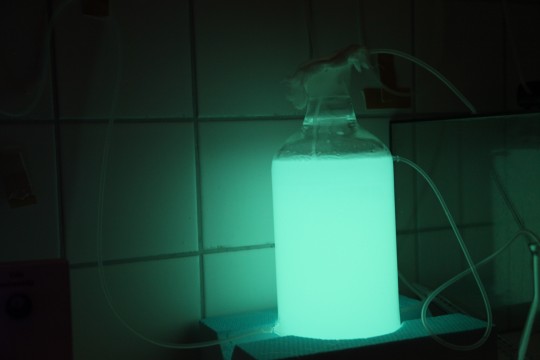
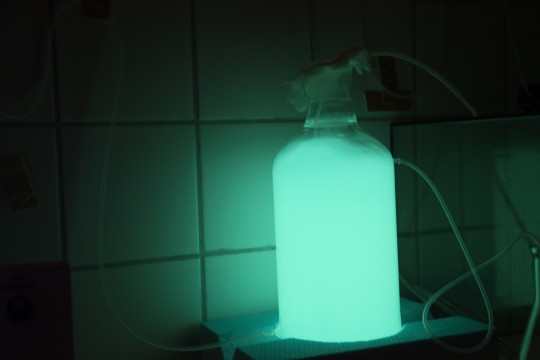
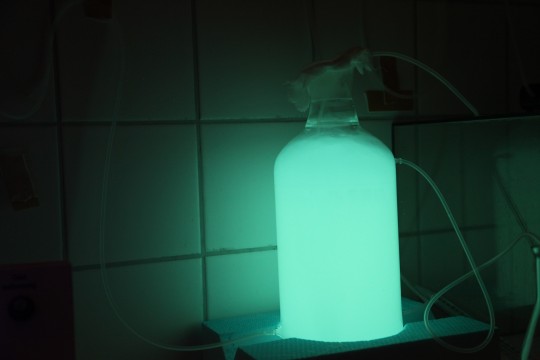
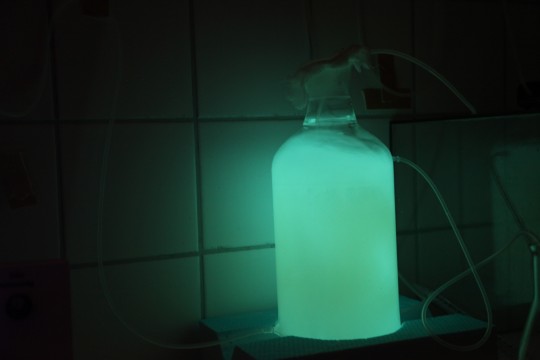
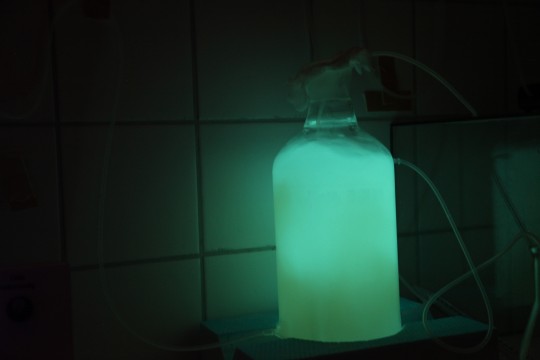
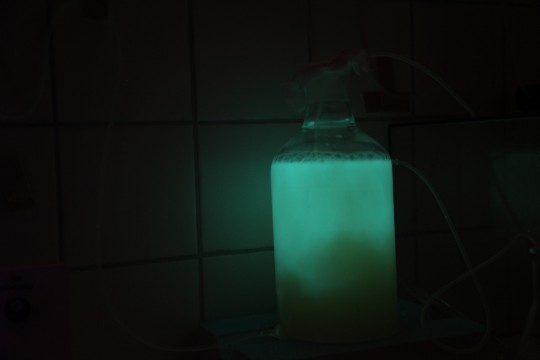
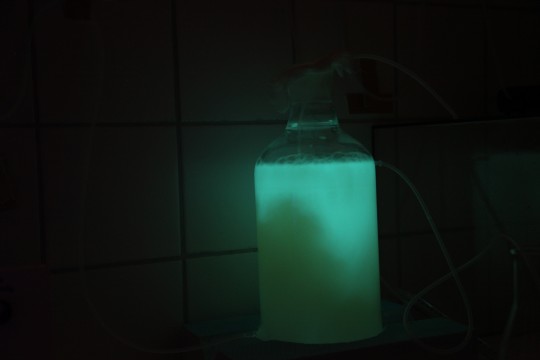
Photobacterium Phosphoreum in a bottle
- Posted by darkeye on September 7th, 2014 filed in experiments, log
- 1 Comment »
Yesterdays experiment with growing Photobacterium Phosphoreum as a liquid culture came to fruition today. It seems that the ‘botched’ liquid culture from two days ago came to light today as well. The following images show the result, in a pitch dark room with some reflection off the wall (well, a tiled bathroom), at 10sec, f/4, ISO 800:
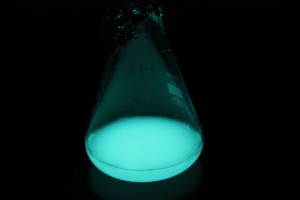
Photobacterium Phosphoreum, 10sec, f/4, ISO 800
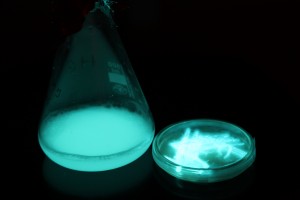
Photobacterium Phosphoreum, 10sec, f/4, ISO 800
In short, I prepared two 100ml cultures (one PP BH and one PP LumA) in a 500ml Erlenmayer flask each, with the following composition each:
- Nutrient Broth: 8g/1000ml -> 0.8g
- NaCl: 30g/1000ml -> 3g
- Glycerol: 10g/1000ml -> 1g
- CaCO3: 5g/1000ml -> 0.5g
The ‘botched’ bottle from two days ago had the same ingredients, but in cca. 180ml of water. The result is well visible in a dimly lit room. I personally can’t tell the difference between the PP HB and the PP LumA variants.
The bacteria light up only when you oxygenize the culture, for example, you shake / stir the liquid culture. after that, it stays visibly bright for about 7 minutes. See the following image sequence, taken in a loosely lit room in 1 minute increments, at 3s, f/4, ISO 800:
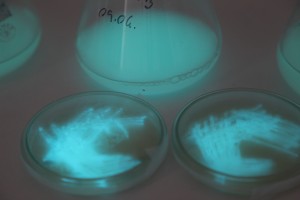
Photobacterium Phosphoreum, right after stirring, 3sec, f/4, ISO 800
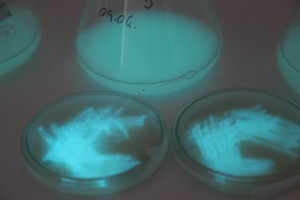
Photobacterium Phosphoreum, 1 minute after stirring, 3sec, f/4, ISO 800
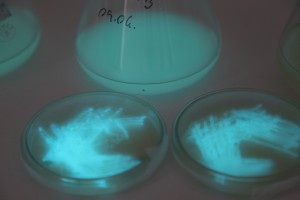
Photobacterium Phosphoreum, 2 minutes after stirring, 3sec, f/4, ISO 800
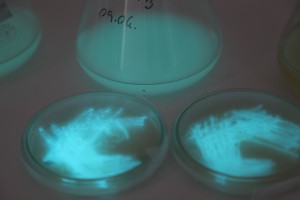
Photobacterium Phosphoreum, 3 minutes after stirring, 3sec, f/4, ISO 800
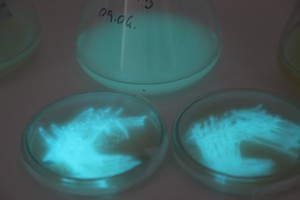
Photobacterium Phosphoreum, 4 minutes after stirring, 3sec, f/4, ISO 800
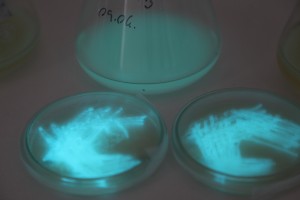
Photobacterium Phosphoreum, 5 minutes after stirring, 3sec, f/4, ISO 800
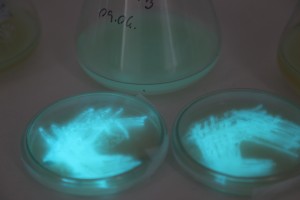
Photobacterium Phosphoreum, 6 minutes after stirring, 3sec, f/4, ISO 800
Photobacterium Phosphoreum, 7 minutes after stirring, 3sec, f/4, ISO 800
Photobacterium Phosphoreum
- Posted by darkeye on September 6th, 2014 filed in experiments, log
- 1 Comment »
Yesterday I did some experiments with Photbacterium Phosphoreum, received kindly from Simon Park, I received two different batches, one simply labeled PP BH, the other PP LumA. I grew out two of each on agar plates, with the following ingredients for 4 plates, 80ml of Agar total:
- Nutrient Broth: 8g/1000ml -> 0.64g
- NaCl: 30g/1000ml -> 2.4g
- Glycerol: 10g/1000ml -> 0.8g
- CaCO3: 5g/1000ml -> 0.4g
- Agar: 15g/1000ml -> 1.2g
I also tried to create a liquid culture, where I botched the ratios and ended up with twice the liquid for the amount of ingredients.
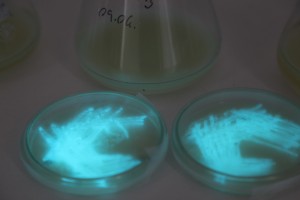
The plates lit up overnight, the liquid culture didn’t. They are quite bright when compared to Vibrio Fischeri. Below are images with various ambient light and photo settings used to take them. other than cropping the first two images, no modification has been made. The two plates on the right left are the PP HB plates, the right ones are the PP LumA plates.
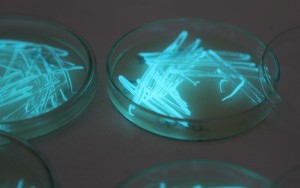
Photobacterium Phosphoreum, 2s, f/4, ISO 800
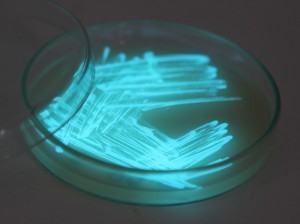
Photobacterium Phosphoreum, 2s, f/4, ISO 800
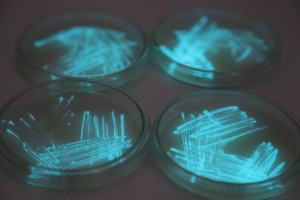
Photobacterium Phosphoreum,
1/2s, f/4, ISO 3200

Photobacterium Phosphoreum, 1/8s, f/4, ISO 3200

Photobacterium Phosphoreum, 1/80s, f/4, ISO 3200
bio.display on the front page of the Hungarian online newspaper HVG
- Posted by darkeye on April 19th, 2010 filed in discussion, log
- Comment now »
the bio.display project is featured on the front page of the Hungarian online newspaper HVG, together with other bio art projects.
- HVG article – in Hungarian
our 3d printer being utilized by hackerspace budapest
- Posted by darkeye on December 3rd, 2009 filed in log, related, software
- 1 Comment »
The Fab@Home 3D printer I used to create the bacteria prints is now being utilized by hackerspace budapest, a new formation created by IT enthusiasts in Budapest, Hungary. I really hope they will make good use of the hardware & contribute to the effort of developing a cross-platform control software for the Fab@Home printer.
Infective Art: Bacterial Photobooth
- Posted by darkeye on November 9th, 2009 filed in log, related
- Comment now »

Simon Park & Anne Brodie have created a photo booth where they take photographs by illuminating their subjects by bacterial bioluminescence – light generated by bacteria – instead of traditional light sources.
The created images are quite interesting.
Printing by growing bacteria on paper
- Posted by darkeye on November 4th, 2009 filed in log, related
- Comment now »
Jelte van Abbema just won the Dutch Radio Prize for his project – printing by letting bacteria grow an fill in the area that should be colored.
Congratulations!
- via de zeen
bio.display presentation at the Budapest New Technology Meetup
- Posted by darkeye on October 7th, 2009 filed in events, log
- Comment now »
Yesterday I had the privilege to present bio.display at the Budapest New Technology Meetup. Here’s the video – albeit in Hungarian:
https://vimeo.com/6943598
Maróy Ákos – bio.display from Budapest New Tech Meetup on Vimeo.
bio.display featured on biopunk
- Posted by darkeye on August 11th, 2009 filed in discussion, log
- Comment now »
